Miseby EDC1/6
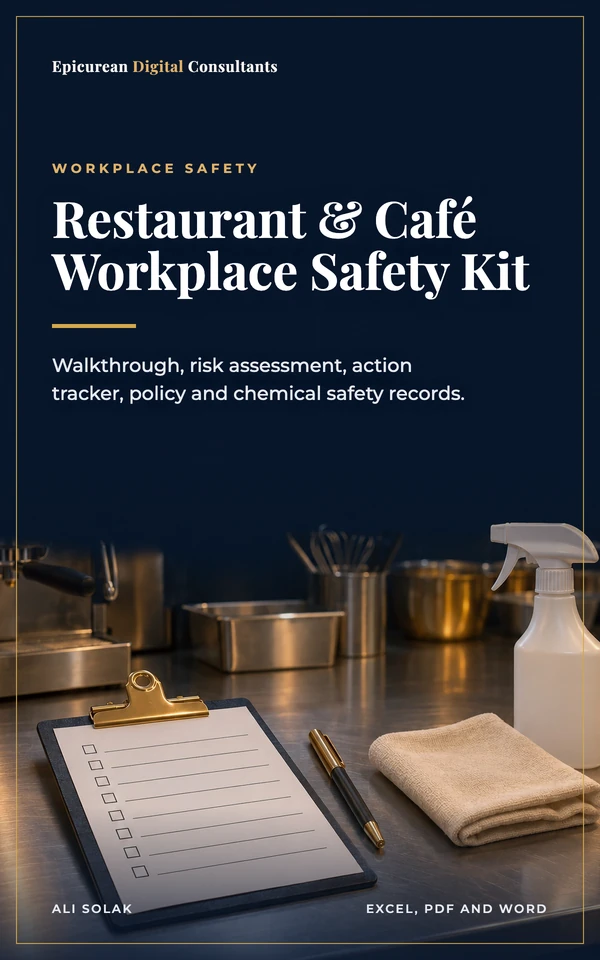
Workplace safety
Walk the venue. Write it down. Give every fix an owner.
60 checkpoints, a risk assessment record and an action tracker for one restaurant, café or takeaway.
A workplace safety kit for one independent restaurant, café or takeaway in England: a 60-point walkthrough, a risk assessment and action tracker workbook, a policy template, staff briefings, and a pack for cleaning chemicals. It is general information and templates, not legal or health and safety advice, and no health and safety professional has reviewed it. It does not certify compliance: you stay responsible for health and safety in your business. It is not a fire risk assessment or a food safety management system. It was written and checked for England. The worked example is a fictional café, and no business shown is a client.
For the owner who knows health and safety paperwork is owed and wants one place to do it.
For: The owner or manager of one independent restaurant, café or takeaway in England.
Workplace safety
60 checkpoints, a risk assessment record and an action tracker for one restaurant, café or takeaway.
In the zip
Built and checked
How to use it
The risks it walks through
Get the kit
£49. Two workbooks, a policy template, briefings and checklists. It does not certify compliance: you stay responsible. Every corrected version free.
Every employer has to assess the risks of the work and manage them. With five or more employees, the significant findings and the health and safety policy have to be written down. The kit gives you one place to do that for the things that hurt people in kitchens and dining rooms: wet floors, knives, hot oil, heavy deliveries, wet hands and cleaning chemicals. This is about the safety of the people who work for you. Food hygiene and fire safety are separate duties, and the kit says so in its start guide and at the head of each section of the walkthrough.
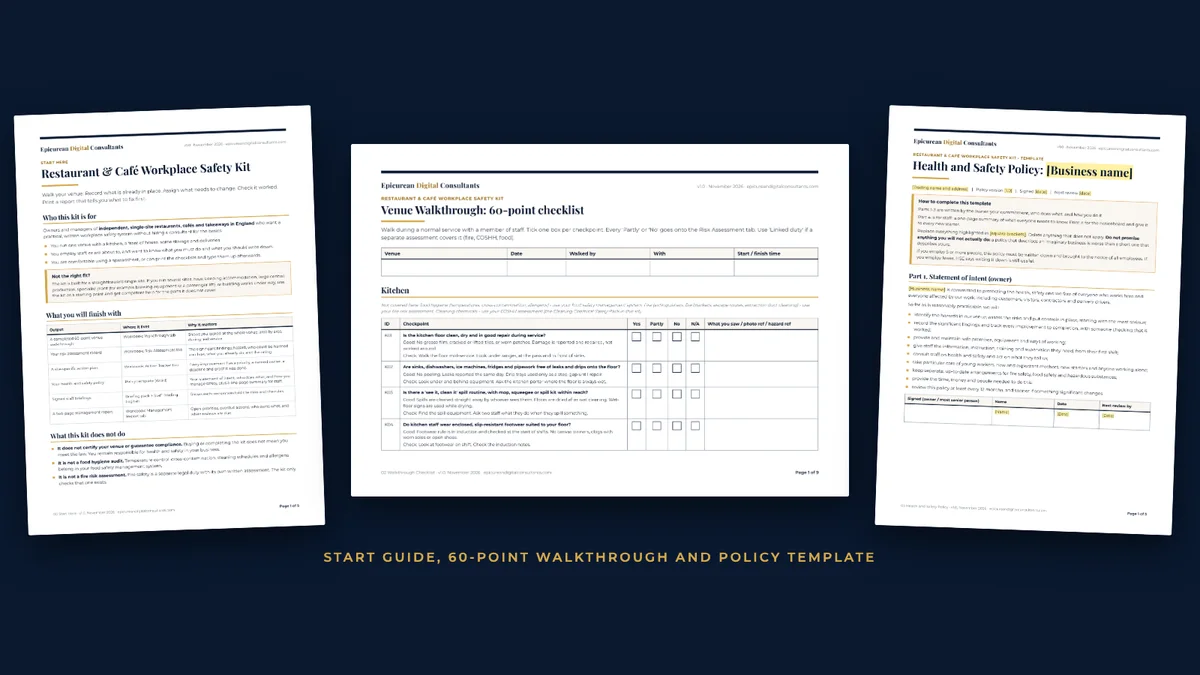
Six areas: kitchen (18 checkpoints), front of house (10), storage (8), deliveries and waste (8), staff areas and welfare (8), and people and arrangements (8). Each checkpoint has a question, what good looks like, and how to check it. You answer Yes, Partly, No or N/A during a real service. It is in the workbook and as a printable checklist for a clipboard.
These 60 checkpoints are about the safety of your staff. The Food Hygiene Rating Kit’s 60 checks are about food hygiene, and the 60-point Audit Kit’s checkpoints are about what a guest sees.
Nine tabs. Every Partly or No becomes a hazard on the Risk Assessment tab, with who could be harmed, what you already do and a rating. Every action goes on the Action Tracker with a priority, a named owner, a deadline and a place to record the evidence that it worked. The risk score and the priority timescales are the kit’s own method, and the workbook says the law does not require them.
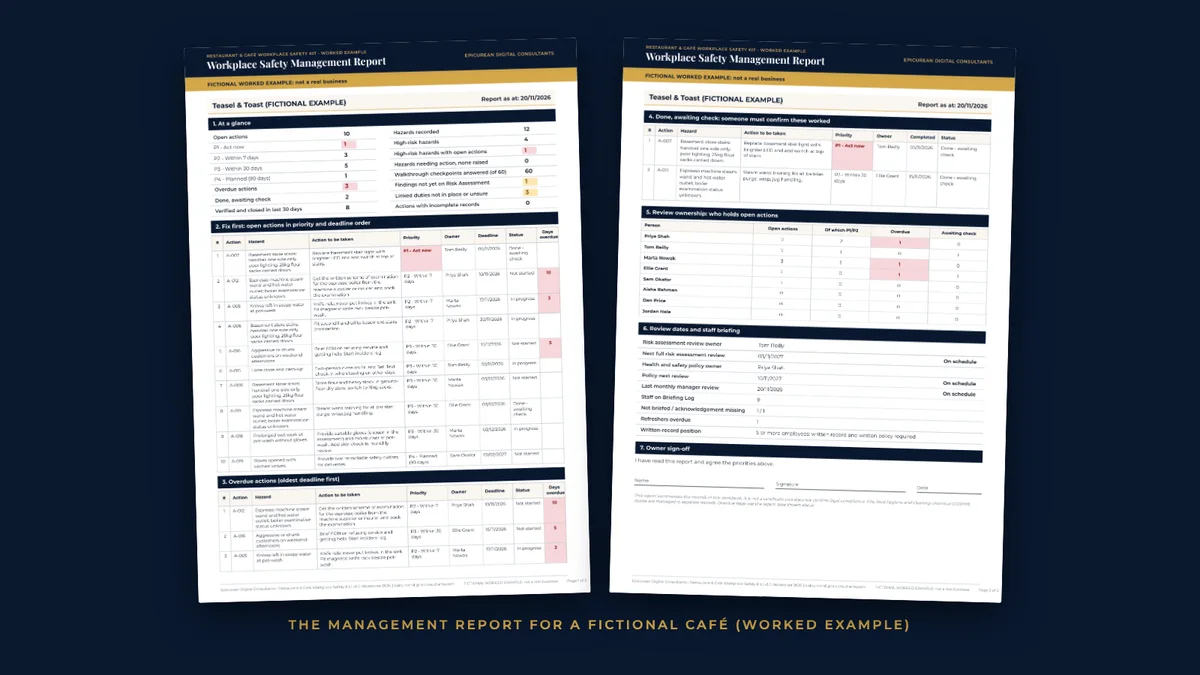
The workbook lays out a two-page report from your entries: open actions in priority order, overdue actions, work done but not yet checked, who holds what, and when the reviews are due, with a line for the owner to sign.
The three parts the Health and Safety Executive describes (statement of intent, responsibilities, arrangements), with 17 short arrangements to edit, and a one-page summary for staff with ten house rules. PDF and editable Word.
A day-one briefing record and acknowledgement, a group sign-off sheet, a quick reference to what must be reported under RIDDOR, and a monthly manager review with the triggers for a fresh look.
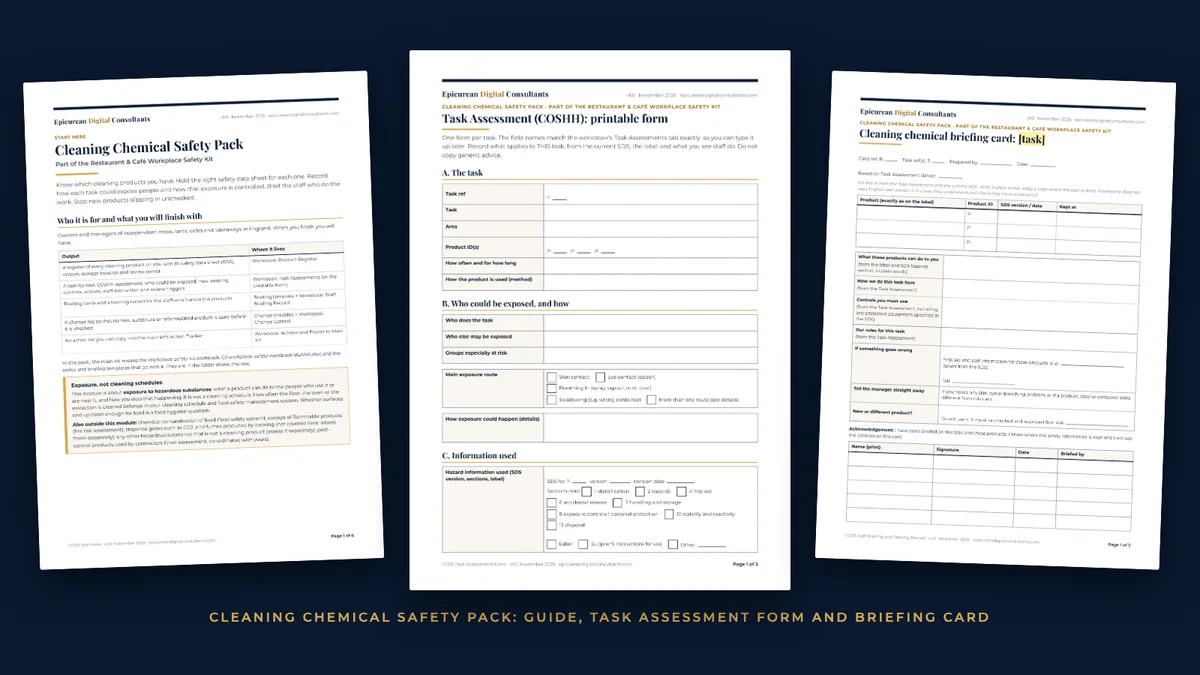
A second workbook (ten tabs) and four documents for COSHH: a register of every cleaning product with its safety data sheet, an assessment for each task, a briefing card and training record, and a checklist to run before a new or substitute product is used. Its actions can be copied into the main workbook’s tracker. It gives no dilution rates, protective equipment specifications or first-aid steps: those come from your supplier’s safety data sheet.
A fictional café, Teasel & Toast, taken from the walkthrough to a checked fix, with both workbooks filled in and the reports they produce. Every page and tab says it is fictional.
The start guides set out what the law requires, who it applies to, and which parts are only the kit’s way of doing it. The rules were read at the Health and Safety Executive, GOV.UK and legislation.gov.uk on 22 November 2026: 102 sources for the main kit and 28 for the chemical pack (127 in all, three being common to both), some long ones only at the passages relied on.
It is not a certificate and it does not make a venue compliant. It is not a fire risk assessment or a food safety management system: it checks that you have them. It is general information, not legal or health and safety advice, and no health and safety professional has reviewed it. It was written for England.
The owner or manager of one independent restaurant, café or takeaway in England who employs staff, or is about to, and wants a written workplace safety system they can keep up themselves.
Groups with several sites, venues with sleeping accommodation, central production kitchens or specialist plant. Anyone who wants a consultant to do the assessment for them. Businesses in Scotland, Wales or Northern Ireland: much of the law is shared across Great Britain, but the kit was checked for England only.

Ali Solak has spent more than twenty years in hospitality operations and leadership, running outlets across five countries. In London he led the multi-site rollout of Simit Sarayı, with sites on Oxford Street, Bond Street, Piccadilly Circus, Leicester Square, Villiers Street, Southampton Row, King’s Road and Green Lanes.
In June 2024 he founded Epicurean Digital Consultants, a London consultancy for independent cafés, restaurants and hospitality brands. It is founder-led: you work with Ali directly, not with an account manager. He is the author of Before You Sign the Lease.
The kit
£49.00
The walkthrough, the risk assessment and action tracker workbook, the policy template, the staff briefing and manager review, the Cleaning Chemical Safety Pack and a worked example.
Free sample report
Free
A two-page management report for a fictional café, as the kit’s workbook lays it out, with a cover page that explains each section.
Food Hygiene Rating Kit 60-point Audit Kit Kitchen SOP Pack Fire Safety Records Pack
Built for the Saturday afternoon when someone new is asked “does this have nuts?”
£19.00See itThirty seconds at table nine: the answer is decided long before the guest asks.
Free sample chapter · from £12.99See itFor the owner who has a food hygiene inspection coming and wants to know where they stand before the officer does.
Free sample poster · from £29.00See it