In detailWhat it does, and what it does not.
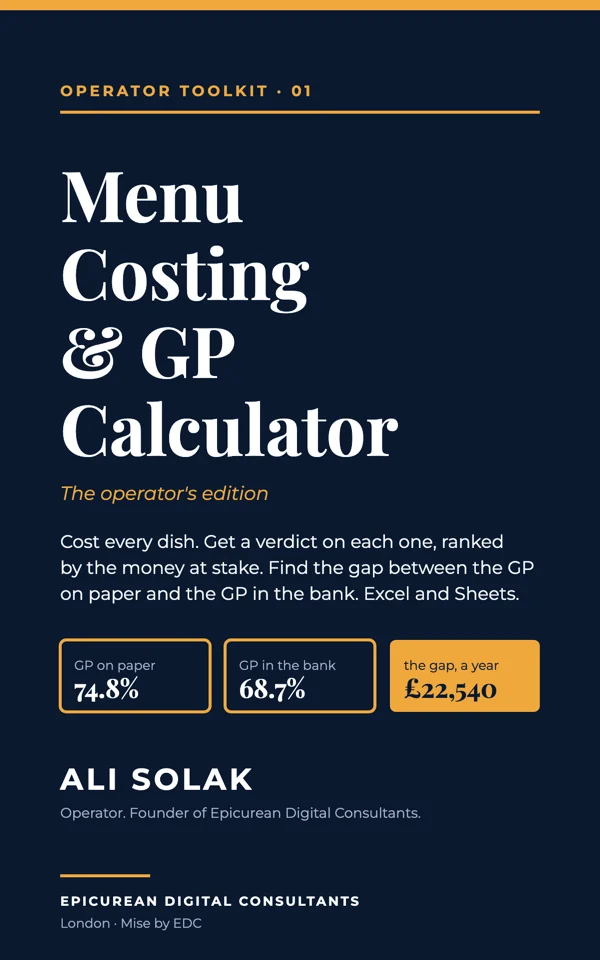
Anyone can get a costing template. What a template cannot give you is the judgement that follows the number: which dish to touch first, where the missing margin is actually going, and what this week’s supplier email will do to the menu. That is what this edition adds, from twenty years of running sites.
Cost every dish
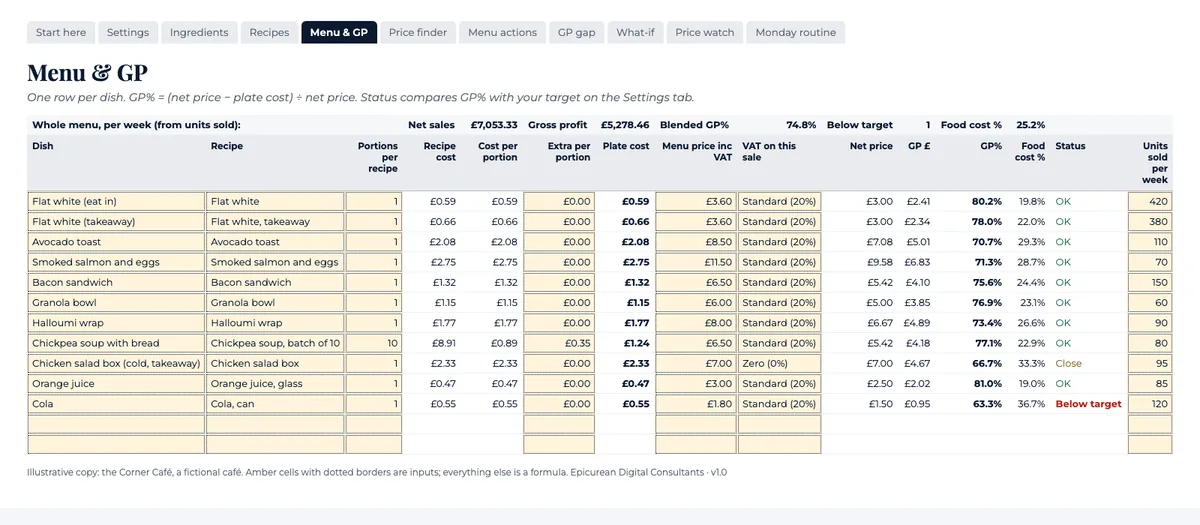
Ingredients with pack size, price, VAT rate and usable yield. Recipes built from them. Menu & GP with plate cost, net price after VAT, GP in pounds and per cent, food-cost %, a status against your target, and the blended GP% of the whole menu from your weekly sales mix. A Price finder for the price each dish needs.
A verdict for every dish
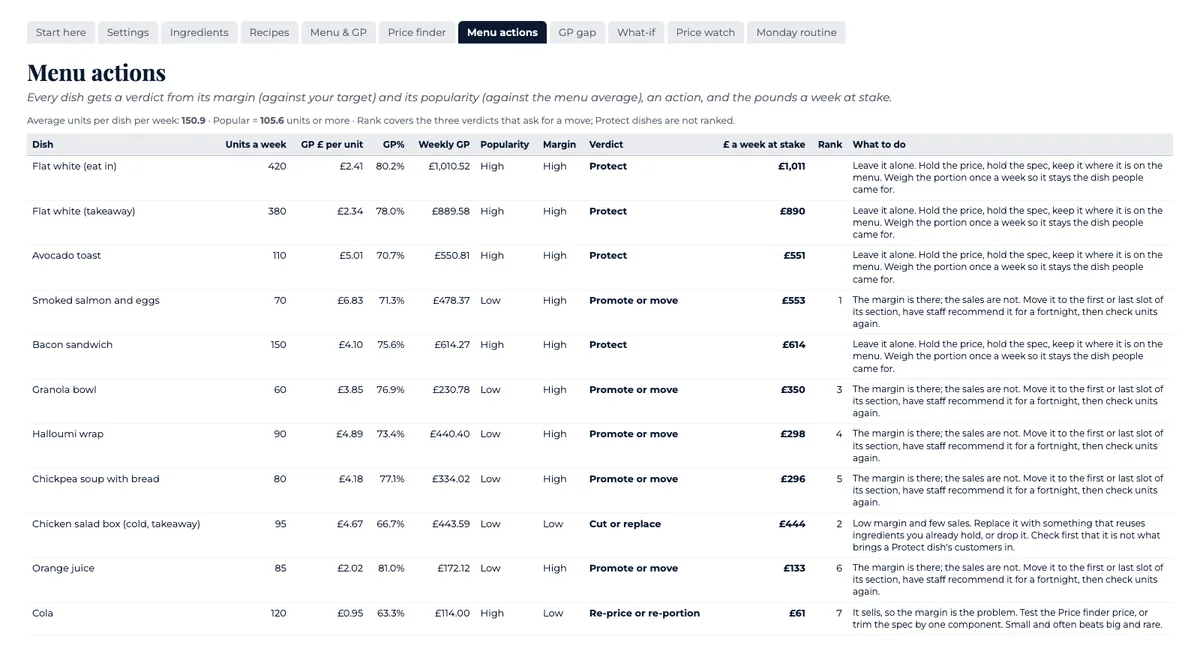
Menu actions reads each dish’s margin against your target and its sales against the menu average, gives it one of four verdicts (protect, re-price or re-portion, promote or move, cut or replace), the action to take, and the pounds a week at stake, ranked. Each verdict carries an “At the table” note from the author.
The GP gap
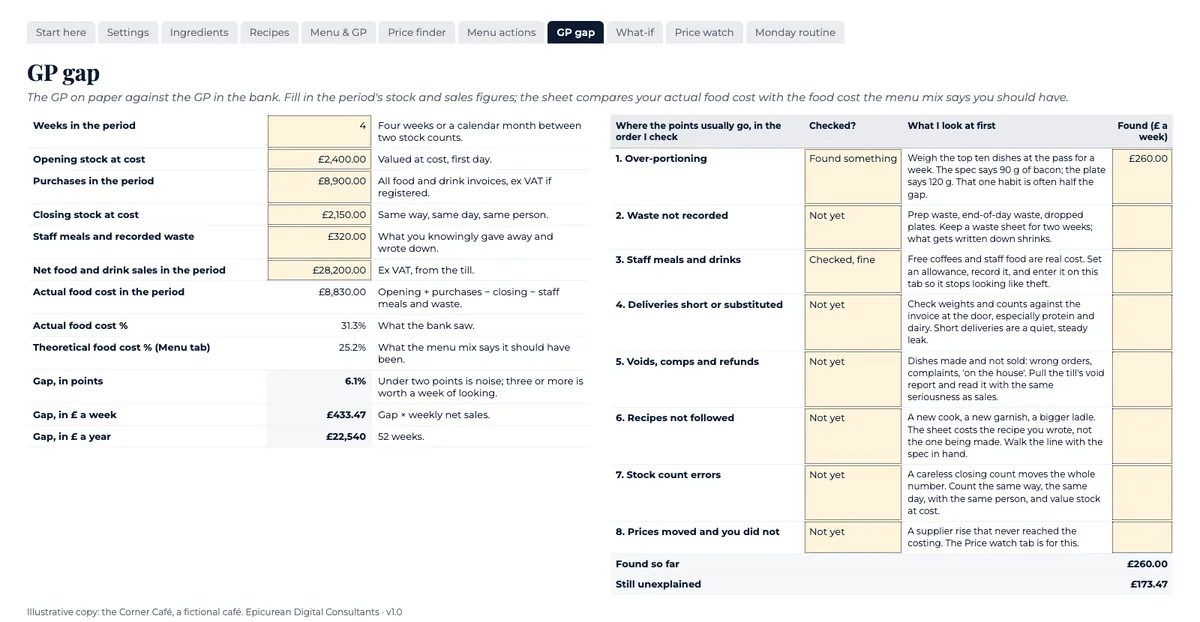
Opening stock, purchases, closing stock, staff meals and sales for the period. The tab works out your actual food cost, sets it against the food cost your menu mix says you should have, and shows the gap in points, pounds a week and pounds a year, with the eight places the points usually go, in the order an operator checks them.
What-if, before you decide
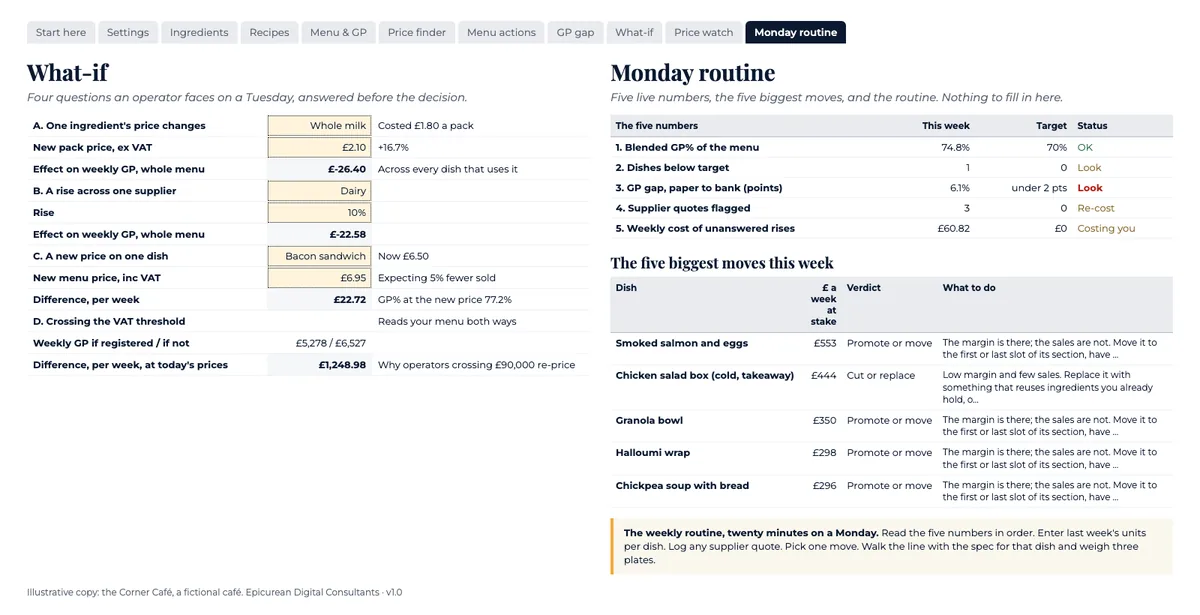
One ingredient’s price changes. A rise across one supplier. A new price on one dish, with the customers you expect to lose. Crossing the VAT threshold. Each one shows the weekly effect on the whole menu.
Price watch and the Monday routine
Log supplier quotes; anything over your trigger flags with its weekly cost. Then five live numbers, the five biggest moves this week, and the twenty-minute routine that keeps the margin.
VAT, handled
Eat-in and hot takeaway at the standard rate, cold takeaway food at zero, the not-registered case, and the rules written out from HMRC’s VAT Notice 709/1 and GOV.UK, read 15 October 2026, with links.
What it is not
It costs ingredients, not labour, rent, energy or delivery commission. GP is not profit. It is not tax, accounting or legal advice. The “At the table” notes are one operator’s experience; your trade will differ.
What you get
An illustrative copy worked through for the Corner Café, a fictional café, so every tab shows what good looks like; a blank copy for your menu; and the six-page operator’s guide. Formulas locked without a password, no macros, every function also in Google Sheets.
Who it is for
The owner or head chef of one independent café, coffee shop or small restaurant in the UK.
Who it is not for
Groups with a purchasing system that already costs recipes. Anyone wanting stock control or ordering; this is costing, pricing and menu decisions only.